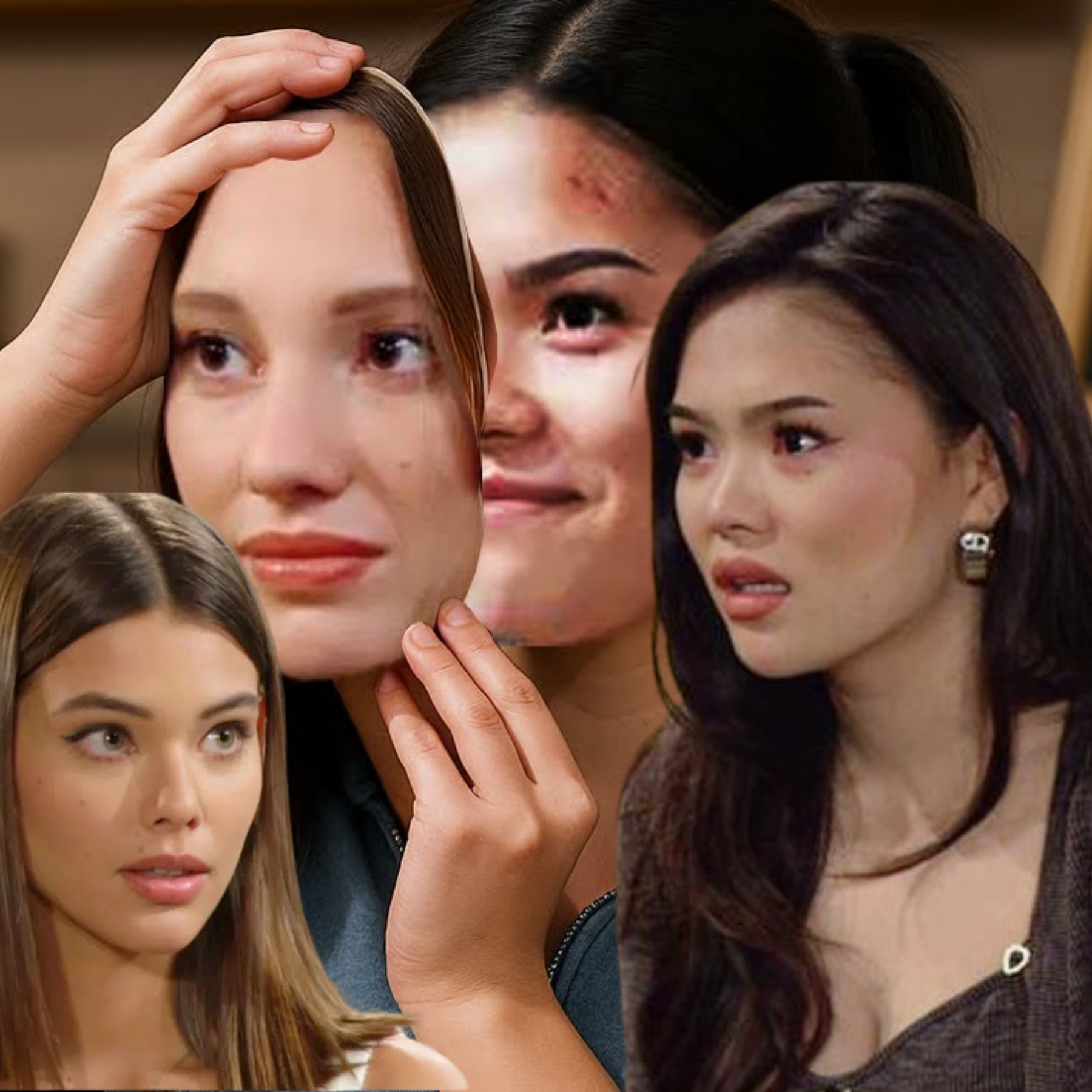
The Bold and the Beautiful | BIGGEST TWIST OF THE YEAR!! Luna wears a Dylan mask to fool everyone
The Bold and the Beautiful just pulled off one of its most audacious story reversals in years — a twist so theatrical it rewrites months of storytelling and flips every character’s motives on their head. In a reveal that will be dissected on message boards, watched frame by agonizing frame, and argued about for weeks to come, Luna Nozzawa is very much alive — and she has been living among the Foresters and Spencers disguised as Dylan Hayes.
The scene that drops this bomb is cinematic and savage in its simplicity. After days of manic confessions, trembling walkabouts, and public self-accusations, “Dylan” returns to her apartment. The trembling stops. The eyes sharpen. The door closes. And one by one a seam comes free: what looked like scalp peels back, revealing not skin but prosthetic edges. The face beneath is Luna’s — smug, satisfied, terrifying. In one perfect, horrifying moment a city that had mourned is told to double-check its grief.
The set-up: why everyone believed the lie

To understand how effective the twist is, you have to appreciate the slow burn that led here. In the aftermath of Luna’s staged death, the canvas emptied of one of its most volatile forces. Characters exhaled. Spoiled relationships appeared salvageable. The Spencers and Foresters tried to rebuild. But the writers seeded doubt early — small inconsistencies, Dylan’s erratic confessions, the missing footage, and the low hum of rumors that the crash wasn’t what it seemed. Dylan’s public breakdowns felt like an attempt at closure, or atonement. Only now do we see they were a master class in misdirection.
By having “Dylan” push the narrative that she was the driver, confessing in tearful, convincing detail, Luna achieved something darker than survival: she manufactured a corpse. She turned grief into an alibi and then watched as the city locked down its mourning. No one looked twice at the living woman walking among them because they had all agreed the other woman was dead.
How it changes motivations — and who’s really playing whom
This twist does more than shock. It forces a total reassessment of motive and agency across the entire ensemble. Dylan — or the body of Dylan that everyone thought they knew — becomes, in retrospect, an instrument of Luna’s design. Scenes that played as unstable contrition now read as rehearsed tactics. The compassion that shielded her becomes, in Luna’s hands, a tool. Finn’s professional care. Steffy’s guilt. Hope’s confusion. All of it was part of a social architecture Luna exploited.
For the Foresters this is catastrophic. Steffy’s anguish at having to reconcile her complicity in a rush to judgment turns to existential guilt. Ridge’s anger will shift: who did he mourn, and who did he forgive? Brooke’s instinct to comfort the troubled will be tested as readers and characters alike question whether trust was misplaced. For the Spencers the fallout is equally seismic. Bill—always the strategist—will see a living threat he may have underestimated. Katie’s maternal protectiveness will curdle into rage and a fierce drive to uncover how deeply she’s been manipulated.
And then there’s Dylan herself: the woman whose identity has been co-opted, mocked, and weaponized. Whether she is alive somewhere else, used as a corpse, or truly gone, the ethical and emotional consequences are enormous. The show now has a moral puzzle to untangle. Who owes whose family an apology? Who owes justice to the real victim?
Luna’s psychology: revenge, freedom, or something darker?
Why would Luna stage her own death and walk the world under another woman’s face? Theories explode with delicious possibilities. Revenge sits closest on the list. Disguised as Dylan, she could move through the Forrester- Spencer network, sowing misdirection, manipulating emotions, and punishing those she believes wronged her. That she chooses Dylan as a mask is cruelly apt: Dylan had proximity, public trust, and a vulnerability Luna could mimic and weaponize.
Another layer is control. To vanish and watch people mourn is to hold power over them in a way obvious survival cannot. Luna becomes both ghost and puppeteer: physically present yet emotionally exorcised. The mask also grants mobility. She can reconstruct relationships, collect intelligence, and orchestrate outcomes without the immediate threat of arrest. If revenge is the engine, control is the steering wheel.
A darker reading suggests Luna’s actions are performative trauma. She revels in the theater of pain—creating mass grief to test who will fight to resurrect truth and who will accept the convenience of closure. That brand of cruelty is classic soap opera villainy elevated into psychological horror.
Immediate consequences: investigations, alliances, and emotional landmines
The moment of reveal detonates multiple immediate threads. Investigators will be forced to re-open lines they closed in grief. Every “evidence” that exonerated Dylan must be reexamined. Footage, forensics, prosthetics, and the origin of the mask itself become the new obsession.
At the same time the interpersonal fallout turns poisonous. Steffy and Finn will ask whether their compassion enabled a predator. Hope, betrayed and horrified, must now reconcile her own grief with the knowledge she was manipulated into silence. Momentum builds for an alliance of characters — not necessarily friends — to hunt down Luna and the people who helped her vanish. That alliance will be messy. Loyalties will fracture. Bill will either become a ruthless counterforce or a scapegoat—maybe both.
And the moral center of the show is shoved into discomforting territory. If one woman survives by letting another be mourned, who receives justice? The show will no doubt frame this as a reckoning: for Luna, for those she wronged, and for a town that preferred a tidy tragedy to an uncomfortable truth.
The craft of the twist: performance, staging, and audience manipulation
From a production standpoint this reveal is a master stroke. It rewards patient viewers while punishing complacency. The prosthetic reveal is staged like a horror film and shot like a high-stakes theater piece: close-ups on hands, beads of sweat, the silence after the door closes. The decision to have Luna remove a mask rather than step out as herself is an act of dramaturgy: it literalizes the theme of identity, posing a simple question — who are we when our faces are currency?
This choice also gives the actors work of the highest caliber. The performer playing “Dylan” had to emulate manufactured breakdowns, then pivot to the cold, clinical Luna beneath. It’s a double role that rewards nuance: the twitch of the eye that suggests calculation, a smile that reads as both triumph and warning.
Where the story can go — and why viewers should care
The plot can split in a dozen delicious ways. Is Luna acting alone? Who provided the mask, the false paperwork, the escape route? Was Dylan a living scapegoat used to fake a death, or did Luna appropriate her face after a darker crime? Each answer reshapes existing alliances and creates new targets for vengeance.
At its heart, this twist asks an old soap question with renewed force: what does identity mean when your face can be faked and your grief weaponized? It forces the canvas to look inward: at privilege, at the limits of trust, and at how quickly a community will close ranks around a tidy narrative.
For viewers, the immediate reward is visceral: the double take when the mask peels away. The longer payoff is moral and emotional: which characters will seek truth, and who will choose the comfort of a lie? Bold and the Beautiful has given itself a blockbuster engine here — a slow-burning hunt with high emotional stakes. Expect courtroom drama, forensic reveals, fractured friendships, and a final moral reckoning that will define this era of the show.