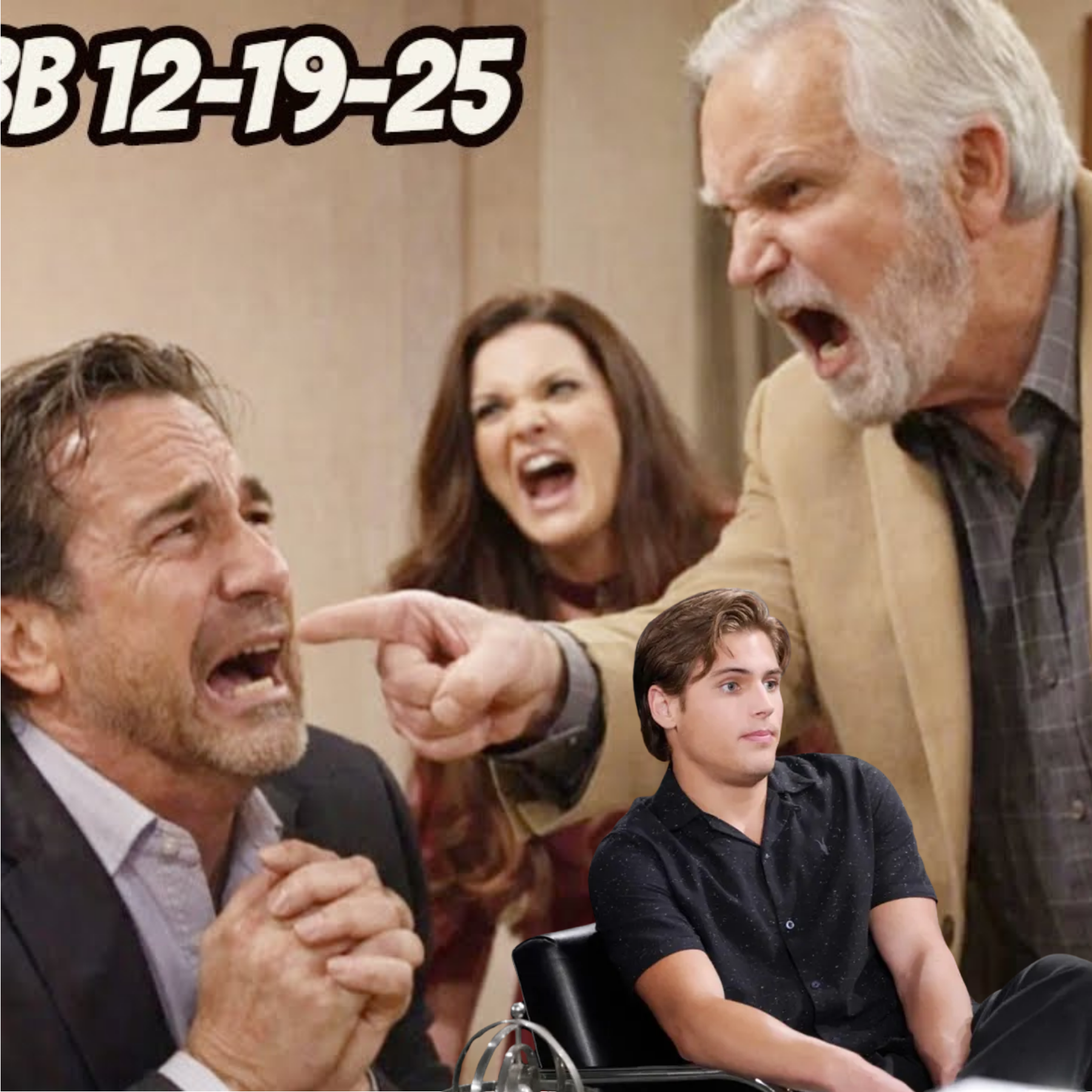
“Power Plays and Broken Bonds: Forester Creations Faces Its Most Explosive Reckoning Yet”
The Bold and the Beautiful 12/19/25 Preview | Next on B&B: Power Shifts, Broken Loyalties, and a Family at War
The Friday, December 19, 2025 episode of The Bold and the Beautiful unfolds with the quiet intensity of a fault line finally giving way. What begins as boardroom strategy and career realignment quickly reveals itself as something far more personal, far more painful. This is not simply a story about fashion houses and creative control—it is a story about identity, relevance, and the devastating cost of being made to feel invisible.
At the center of this emotional storm is Eric Forrester, the patriarch whose name is stitched into every seam of Forester Creations. For decades, Eric built his life on vision and instinct, believing that creation itself was a form of immortality. Forester Creations was never just a business—it was his heartbeat. Yet as leadership quietly shifted, Eric began to feel something far more damaging than age or illness: erasure.
Ridge Forrester, the son Eric trained and entrusted with his legacy, insists his decisions are about progress and modernization. But to Eric, the change feels surgical and cold. Meetings happen without him. Decisions are made in rooms where his voice is no longer requested. There is no dramatic confrontation, no declaration of dismissal—just a polite, suffocating finality that tells Eric his time has passed.
Eric tries to accept this fate with dignity, convincing himself that retirement is a privilege. But the silence that follows is unbearable. Without sketches to refine or fabrics to touch, his days stretch endlessly. Creativity is not a habit Eric can turn off—it is his identity. And without it, he feels hollow.
The deepest wound is not the loss of authority, but the sense that Ridge no longer sees him as relevant.
It is in this vulnerable state that Eric reaches out to Katie Spencer, a woman who has recently made a bold choice of her own by stepping away from Forester Creations. Katie’s decision to embrace uncertainty over stagnation resonates deeply with Eric. Their late-night conversation is not one of rebellion, but of recognition. Both have felt sidelined. Both have felt their worth quietly diminished.
Katie reveals she is building something new—a fashion house unburdened by legacy and expectation. And in that moment, the unthinkable becomes possible. Eric designing again. Not as a ceremonial figurehead, but as a creator with purpose. Loyalty gives Eric pause, but survival pushes him forward. In the end, he chooses himself.
The results are explosive.
Freed from constraints, Eric’s creativity surges. His designs are bold yet refined, modern yet unmistakably his. Buyers take notice. Critics praise the craftsmanship. What begins as a modest venture quickly disrupts the fashion world. The irony is brutal—Eric’s work, once implicitly deemed outdated, is now celebrated as visionary.
Soon, Forester Creations can no longer ignore the rising competitor in its territory. When Ridge and Brooke discover Eric is behind the designs, the sense of betrayal is immediate. For Ridge, the revelation cuts deeply. He believed he was honoring his father’s legacy, not erasing him. Now he must confront the possibility that his leadership pushed Eric away.
Brooke’s reaction is equally conflicted. She is hurt, regretful, and afraid. Forester Creations is the foundation of her life, and now that foundation is being challenged by one of its own architects. Confrontations follow—raw, honest, unresolved. Eric does not apologize for creating again, but he speaks openly about what it felt like to be sidelined. Ridge listens, torn between defensiveness and guilt. Brooke realizes this fracture has been years in the making.
Katie finds herself caught in the fallout as well. She refuses to apologize for giving Eric a place to thrive. Her company’s success, she insists, is not aggression—it is proof of what happens when talent is trusted.
As this rivalry intensifies, another battle erupts within Forester Creations itself.
Hope Logan Spencer is reeling from Steffy Forrester Finnegan’s latest decision: Thomas Forrester is back, and Deacon Sharp has been cut loose. For Hope, this is not just a staffing change—it is an erasure. Hope for the Future was never just a line; it was her declaration of independence, a space she fought to shape on her own terms. Thomas’s sudden return threatens to destabilize everything she has worked to build.
Hope does not deny Thomas’s talent. What she objects to is the timing and the lack of consultation. The line was moving forward under a vision rooted in trust and stability. Thomas’s arrival feels invasive, reopening emotional wounds Hope has struggled to heal.
Steffy, however, sees Hope’s resistance as sentimentality masquerading as strategy. In Steffy’s world, leadership requires compartmentalization. Personal discomfort cannot dictate business decisions. Pairing Thomas with Zende Forrester Dominguez is, to her, not just logical—it is inevitable. Legacy, brand recognition, and control must come first.
Hope argues that Deacon deserves to stay. His work has been integral. His presence has provided continuity. Keeping him would signal fairness and respect beyond bloodlines. Steffy’s response is swift and final. There is no room for Deacon. The decision is not up for debate.
This moment marks a decisive fracture between the two women. Hope is forced to confront the painful truth that her influence is conditional, always subject to legacy power. Steffy stands firm, convinced that difficult choices define leadership—even when they leave emotional wreckage behind.
Elsewhere, Katie faces a reckoning of her own.
When she reveals to Brooke that she has accepted Bill Spencer’s offer to launch her own fashion brand, she hopes for support. Instead, she is met with hesitation and unease. Brooke cannot understand why Katie would walk away from Forester Creations—a company central to their shared history—only to become a competitor.
To Brooke, the move feels impulsive, even disloyal. To Katie, it feels like clarity. Staying has begun to erode her sense of self. Bill’s offer is not just an opportunity—it is validation. Katie knows this choice may create distance, but she is no longer willing to sacrifice growth for harmony.
As the episode draws to a close, it becomes clear that none of these conflicts will be easily resolved. Eric’s decision to create again has reignited old wounds. Hope’s authority over her own line has been undermined. Katie’s independence challenges family loyalties. Steffy and Brooke, each in their own way, must face the limits of control.
This episode of The Bold and the Beautiful is less about fashion and more about survival. About what happens when people refuse to disappear quietly. When legacy collides with autonomy. When choosing oneself comes at the cost of relationships long taken for granted.
Forester Creations remains standing—but it is irrevocably changed. And the choices made on December 19 will echo far beyond the runway, shaping not just careers, but the fragile bonds holding this family together.