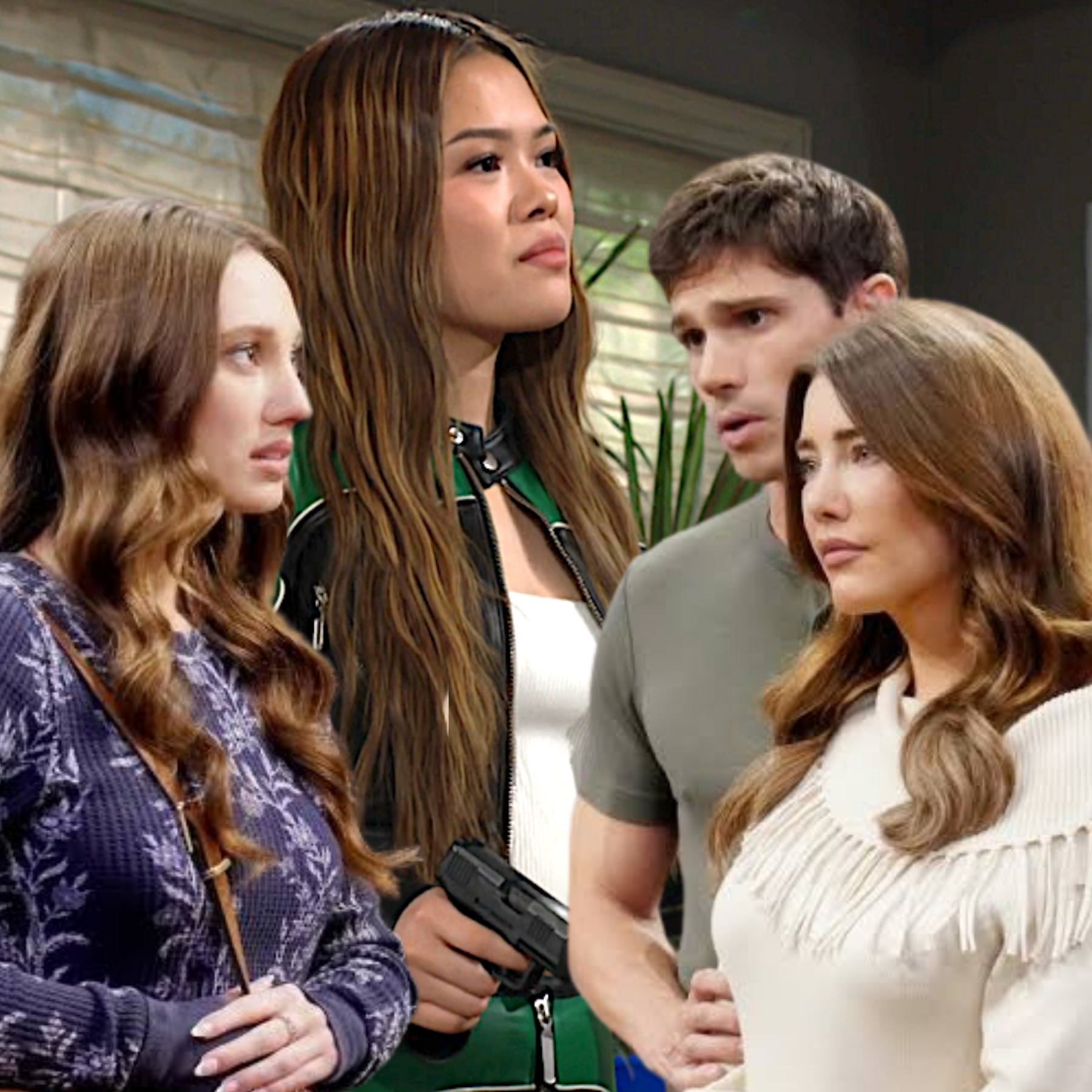
The Bold and the Beautiful Spoilers: Luna Reappears and Reveals Dylan’s True Identity
Los Angeles woke up to a television shake-up this week as The Bold and the Beautiful delivered one of its most seismic shocks in recent memory: Luna Nozzawa — long presumed dead — has returned to the canvas, and her reappearance unspooled a truth that threatens to topple the delicate scaffolding of the Forester and Spencer worlds. In a storyline equal parts revenge drama and identity mystery, Luna’s revival drags a host of characters into a moral and emotional cyclone — and at its eye sits Dylan, whose life is about to be redefined.
A Return That Stops the City Cold
Luna’s resurrection didn’t arrive with fanfare so much as a slow clarion call. First, a blurry photograph on a cliffside, then a shock visit to Forester Creations. The woman who once haunted the city with chaos and stunt-plot theatrics returned calm and chillingly composed. She didn’t beg for forgiveness. She didn’t ask for sympathy. Instead, she delivered a single, devastating revelation: the body the city buried — the woman everyone assumed had been run down — was not her. Someone else took that fall. Someone whose death had been mistaken for Luna’s.
The immediate fallout is cinematic: journalists circling, legal teams mobilizing, and the Forester and Spencer families thrust back into the kind of public scrutiny they thought they had survived. But the crux of the storm is the personal. Luna’s claim pulled a thread that unraveled a life — Dylan’s — and exposed a secret so deep it redefines family, culpability, and identity.
Dylan: From Confessor to Catalyzed Conscience
For weeks, Dylan had been portrayed as a woman undone by guilt. She wandered Forester Creations and hospital corridors, confessing she’d hit Luna in a hit-and-run. The confession had been her penance: a blunt, anguished attempt to atone for a death she believed she caused. But Luna’s revelation flips that narrative: Dylan did not kill Luna — she was manipulated into confessing to a crime that never occurred the way they thought. Worse, the admission may have served someone else’s purpose.
The show smartly layers Dylan’s arc as more than a simple victim. Her confession, whether coerced, staged, or born from trauma, becomes the instrument Luna used (or allowed) to create a myth of finality. Dylan’s willingness to wear guilt like a cloak made her the perfect decoy in a much larger scheme, and the truth about her origins and involvement now threatens to tear at her sense of self.
Family Fault Lines: Forester Loyalties on the Line

If there’s a family that knows how to survive scandal, it’s the Foresters — and yet Luna’s reappearance exposes fault lines that decades of reunions and reconciliations hadn’t fixed. Ridge is furious, stunned by the possibility that the narrative he and his family rested on was a lie. Steffy is enraged, feeling that closure was stolen from her, while Finn is pulled between his oath as a doctor and the emotional chaos this revelation unleashes.
Moreover, the boardroom becomes a battlefield. Forester Creations, once an emblem of legacy, now fights reputational damage as anonymous leaks and Luna’s accusations of corruption and theft surface. Investors start to jitter; social media has a field day; and the company’s internal alliances — practiced at secrecy and spin — begin to fray.
The Moral Collision: Who Is Dylan, Really?
At the heart of the story is a question that soap opera drama excels at making existential: who are we when the facts we anchor our lives to disappear? Dylan goes from being the tormented confessant to an accidental cipher. If she did not kill Luna, who did she hit that night — and why was that other woman wearing Luna’s uniform? Luna claims she orchestrated the switch to make sure the world accepted her death; others whisper that Dylan was a pawn or a scapegoat.
What complicates matters further is evidence: files, signatures, and a clandestine trail that suggests Dylan’s history is more than eroded memory. The show uses these breadcrumbs to make viewers doubt Dylan’s agency. Was she naïve? Complicit? Or a deeply bruised person whose narrative was exploited by someone with a thirst for revenge?
Finn, Stephie and the Ethics of Empathy
Finn’s role is wrenching in this. A physician with moral certainties, he performed the autopsy — or at least believed he had. Now that the assumptions built into his work are called into question, his credibility and his marriage to Steffy become collateral. Steffy’s fury is both personal and political: Luna’s reemergence collapses her hard-won sense of safety and forces her to confront a marriage built on partial truths.
Their relationship becomes the emotional lodestone of this arc: Finn, driven to find facts; Steffy, driven by wounded pride and the need to protect a family identity; and between them, the public’s appetite for salacious answers. The ethical dilemmas posed by Finn’s professional involvement and the personal betrayal felt by Steffy make for taut, watchable television.
Luna’s Strategy: Exposure Over Violence
Interestingly, Luna’s revenge is mostly procedural and psychological, not purely violent. She teams public humiliation with real documents — leaked contracts, forged autopsy addendums, and subtle financial trails — to dismantle reputations. It’s less about blood and more about the death of credibility. In this sense, her war is suited to the 24/7 news cycle: she knows how to make the right tweet, plant the right rumor, and blow open fissures in corporate governance.
And by centering Dylan, Luna’s strategy demonstrates a cruel genius: control the narrative by controlling who is believed dead and who is alive. If the public is persuaded that the corpse wasn’t Luna’s, the established story collapses. What remains is a city forced to confront how easily truth can be manufactured.
What This Means for B&B — And for Viewers
Luna’s return is not merely a plot twist; it’s a pivot. The series is shifting from revenge-of-the-moment beats to a long-form, identity-driven mystery that will force characters to ask: what is justice when truth is a commodity? Dylan’s identity crisis will likely be the emotional engine for months to come, as she tries to reclaim agency, find the woman whose life she inadvertently ended, and repair fractured relationships.
For fans, the stakes are both intimate and epic. Viewers get a satisfying, twist-heavy arc that challenges loyalties and forces beloved characters into moral gray zones. For the show, it’s a chance to mine deep character work from its ensemble — Finn’s conscience, Steffy’s fury, Ridge’s pride, and Dylan’s fragile resilience — while keeping the ratings-hungry public riveted.
One thing is certain: Luna’s reappearance has already rewritten the rules. In Los Angeles, in a city built on reinvention, the dead can return — and when they do, they carry the power to change everything.